

Legal and accounting firms
The Electronic Archiving System (EAS) for legal and accounting firms meets the specific needs of document preservation, search, and protection of confidential documents. It ensures the probative value of archives while complying with the legal obligations specific to these regulated professions.
Specific needs of the sector
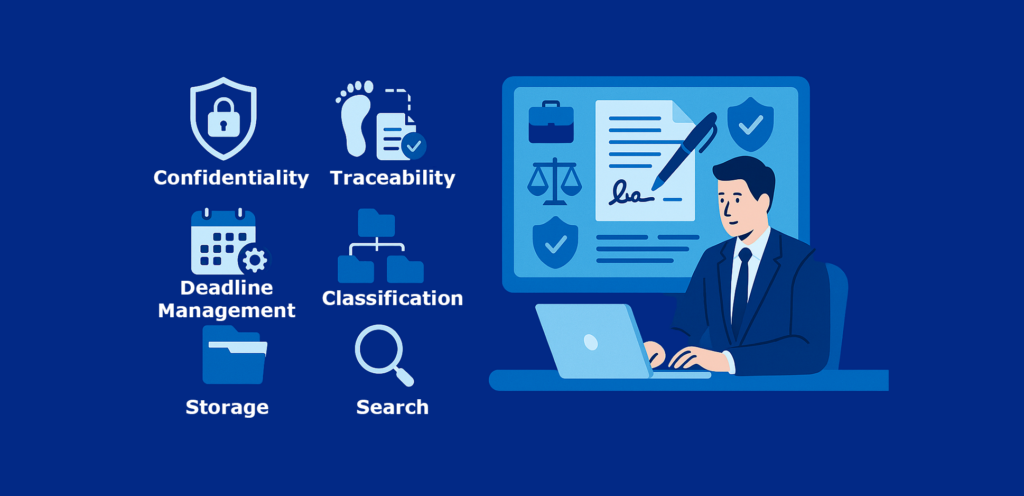
Enhanced confidentiality: Protection of sensitive client data covered by professional secrecy;
Comprehensive traceability: Complete tracking of access and actions on archived documents;
Probative preservation: Legally valid archiving for contracts and legal acts;
Deadline management: Automation of document lifecycle according to legal retention periods;
Intelligent classification: Organization by client, case, procedure type or assignment;
Advanced search: Ability to quickly retrieve documents from large volumes;
Interoperability: Integration with legal and accounting professional software.
Strategic advantages
Enhanced protection of professional secrecy and confidential data;
Significant time savings in searching and consulting case files;
Reduction of legal risk related to loss or alteration of probative documents;
Work space optimization, freed from physical archives;
Improved mobility for professionals working outside the firm;
Secure document sharing with clients or courts;
Guaranteed compliance with ethical and regulatory obligations.
Documents concerned and retentions periods
Technical and normative requirements
Compliance with standards: NF Z42-013, ISO 14641, and NF 461 certification;
Data encryption to ensure confidentiality of sensitive information;
Qualified electronic signature for binding documents;
Certified timestamping to guarantee date and time of operations;
Digital fingerprints to verify document integrity over time;
Strong user authentication with access traceability;
Logging of all operations performed on documents.
Legal and regulatory aspects
Compliance with professional ethics rules of professional orders (lawyers, chartered accountants);
Compliance with GDPR requirements on personal data protection;
Respect for professional secrecy imposed on lawyers and chartered accountants;
Application of legal retention periods, varying by document type;
Consideration of opposability rules for electronic documents.
Practical recommendations
Define an archiving policy tailored to the firm’s specificities;
Implement precise nomenclature for case file classification;
Train staff in best practices for electronic archiving;
Establish strict authorization levels for document access;
Plan regular compliance and security audits of the EAS;
Automate deposits from daily professional software;
Plan backup procedures in case of system unavailability.