
Banking and Financial sector
The Electronic Archiving System (EAS) in the banking and financial sector enables the preservation, security, and enhancement of institutions’ informational heritage while ensuring regulatory compliance. It is a strategic tool that provides probative archiving for digital and dematerialized documents.
Specific needs of the sector
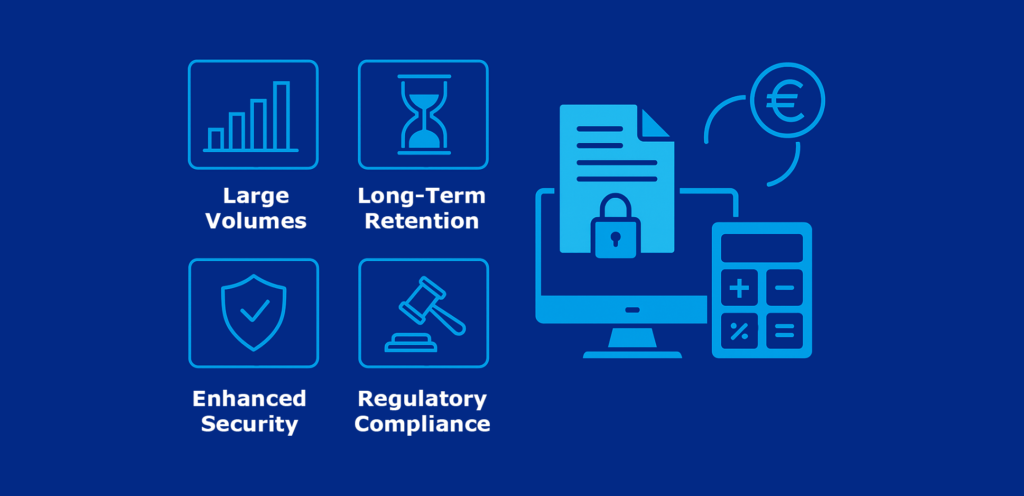
Massive volumes: Ability to rapidly archive billions of banking records within a single system;
Long-term preservation: Management of documents with retention periods exceeding 10 years;
High availability: Rapid access to archives and supporting documents within seconds;
Probative value: Preservation of the legal force of dematerialized documents;
Enhanced security: Protection of sensitive client data with strict access levels;
Regulatory compliance: Adherence to specific banking regulations (PSD2, GDPR, etc.).
Strategic advantages
Reduction of legal risks during regulatory inspections;
Process optimization and time savings in document retrieval;
Securing sensitive data in compliance with financial sector requirements;
Complete traceability of access and modifications for audits;
Cost reduction related to physical document storage;
Business continuity assured through permanent archive availability.
Documents concerned and retentions periods
Technical and normative requirements
Compliance with standards: NF Z42-013, ISO 14641;
Secure infrastructure: Highly secure data centers with data duplication;
Security mechanisms: Timestamping, hash calculation, integrity verification;
Traceability: Logging of all actions performed on documents;
Certification: NF 461 certified system recommended.
Legal and regulatory aspects
GDPR compliance for client personal data protection;
Compliance with sector-specific regulations such as PSD2 and PCI DSS;
Application of European directives on banking data retention;
Compliance with CNIL recommendations on data retention periods.
Practical recommendations
Audit specific needs of the banking institution before deployment;
Train teams in EAS usage to maximize adoption;
Implement clear document governance (classification, metadata);
Automate deposit processes from business applications;
Plan regular integrity checks on archives;
Define a document lifecycle management policy;
Plan scalability capacity to accommodate volume growth.