

The Electronic Archiving System (SAE) for professional archivists is a fundamental tool for preserving informational and cultural heritage. It addresses the specific needs of public and private archive services and heritage institutions by guaranteeing the authenticity, integrity, and long-term preservation of documents over very long periods of time.
SPECIFIC NEEDS OF THE SECTOR
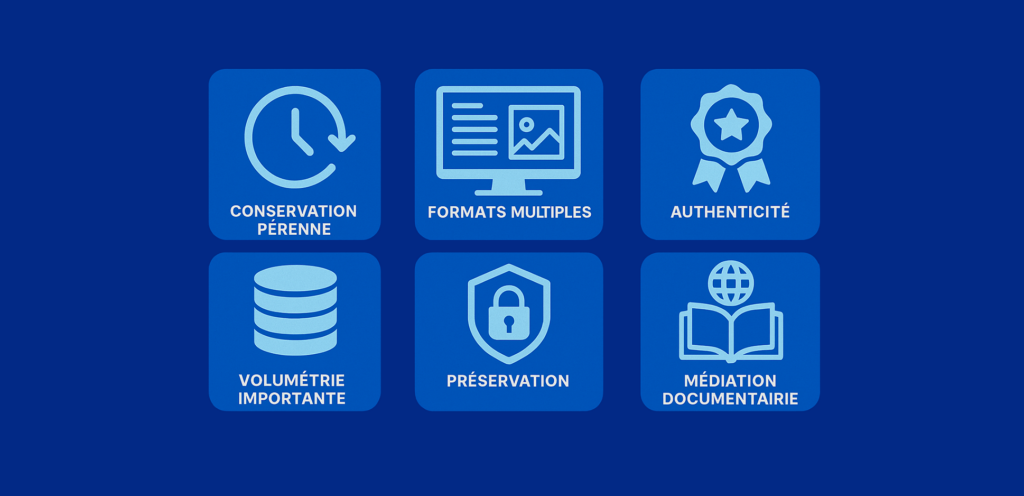
Long-term preservation: Preservation over several decades, or even several centuries;
Management of multiple formats: Ability to archive all types of documents (text, image, sound, video);
Standardized archival description: Compliance with description standards (ISAD(G), EAD, etc.);
Preservation of authenticity: Guarantee of the origin and integrity of documents;
Format migration: Ability to evolve formats to ensure readability;
High volume: Massive storage capacity for complete heritage collections;
Document mediation: Tools for enhancing and disseminating digital heritage.
STRATEGIC ADVANTAGES
Preservation of collective memory and historical heritage;
Democratized access to archives through online availability;
Scientific and cultural enhancement of archival collections;
Protection against physical risks (deterioration, fire, flooding);
Optimization of traditional storage spaces;
Pooling of resources between heritage institutions;
Potential international dissemination of digitized collections.
DOCUMENTS CONCERNED AND RETENTION PERIODS
TECHNICAL AND NORMATIVE REQUIREMENTS
Compliance with the OAIS model (Open Archival Information System, ISO 14721 standard);
Compliance with standards: NF Z42-013, ISO 14641, and associated certifications;
Interoperability with other archival systems via standard formats;
Format sustainability with automated conversion if necessary;
Full traceability of all actions on documents;
Management of metadata (descriptive, technical, and preservation);
Classification scheme compliant with archival practices.
LEGAL AND REGULATORY ASPECTS
Clear collection policy defining the scope of archives to be digitized;
Digitization strategy establishing priorities and technical standards;
Management of rights of access, reproduction, and reuse;
Public communication of archives in compliance with legal time limits;
Cultural promotion through virtual exhibitions and publications;
Possible collaborative indexing to enrich descriptions;
Hybrid preservation coordinating physical and digital archives.
PRACTICAL RECOMMENDATIONS
Define a clear archiving policy before any technical deployment;
Adopt open standards to guarantee interoperability and sustainability;
Train teams in the specificities of heritage electronic archiving;
Implement a digital preservation plan over the very long term;
Plan regular migrations to new formats if necessary;
Develop partnerships with other institutions to pool resources;
Integrate an educational dimension to facilitate access to archives.