

The Electronic Archiving System (EAS) tailored for the real estate sector enables the management and security of all documents related to real estate properties, transactions, and relationships with various stakeholders. It ensures the probative preservation of documents and facilitates their consultation throughout their lifecycle.
SPECIFIC NEEDS OF THE SECTOR
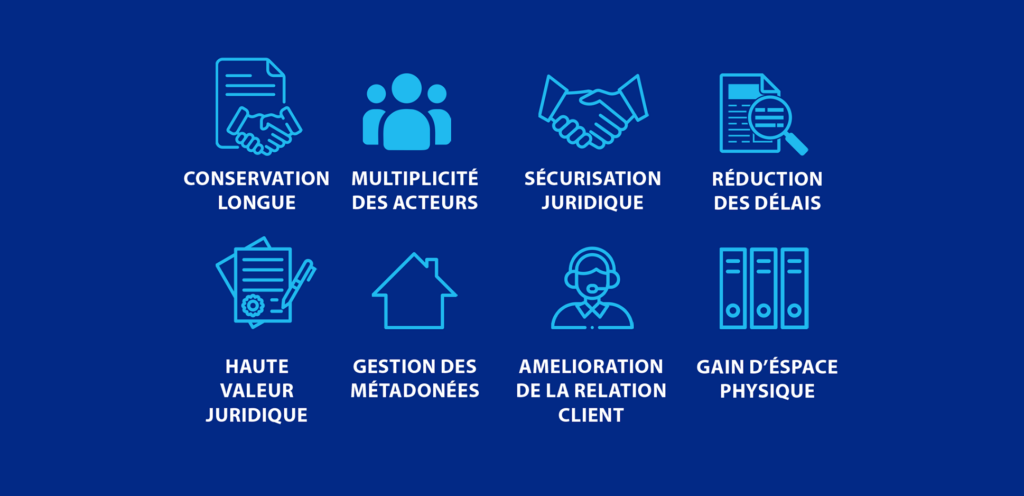
Long retention periods: Preservation of property deeds and land registry documents for several decades;
Multiple stakeholders: Access management for different parties (agents, notaries, buyers, sellers);
High legal value documents: Secure preservation of contracts, notarized deeds, and other probative documents;
Exchange traceability: Tracking of communications between various stakeholders;
Real estate metadata management: Advanced indexing by property, transaction, or client;
Multi-format archiving: Management of plans, photographs, and large technical documents.
STRATEGIC ADVANTAGES
Legal security for real estate transactions and contractual documents;
Reduced processing times for document search and transmission;
Improved client relations through rapid access to information;
Optimized property management and property monitoring;
Regulatory compliance with sector obligations;
Significant physical space savings for real estate agencies;
Enhanced informational heritage of the company.
DOCUMENTS CONCERNED AND RETENTION PERIODS
TECHNICAL AND NORMATIVE REQUIREMENTS
Compliance with standards: NF Z42-013, ISO 14641 for probative archiving;
Scalable storage capacity for plans and large technical documents;
Integrated visualization of specific formats (CAD, architectural plans);
Detailed indexing to easily retrieve documents by property;
Compatible electronic signature with real estate transaction requirements;
Interfaces with industry-specific software for real estate.
LEGAL AND REGULATORY ASPECTS
Compliance with ALUR law and various real estate regulations;
Compliance with Hoquet decree requirements for real estate professionals;
Application of personal data protection rules (GDPR);
Document retention according to specific legal deadlines for real estate transactions;
Compliance with anti-money laundering obligations (AML-CFT).
PRACTICAL RECOMMENDATIONS
Structure the archive tree by properties and transaction types;
Define specific real estate metadata to facilitate searches;
Implement tailored workflows for real estate transaction lifecycles;
Train staff in best practices for archiving sensitive documents;
Plan differentiated access levels based on user profiles;
Automate SAE feeding from property management tools;
Organize regulatory monitoring on legislative developments in the sector.