
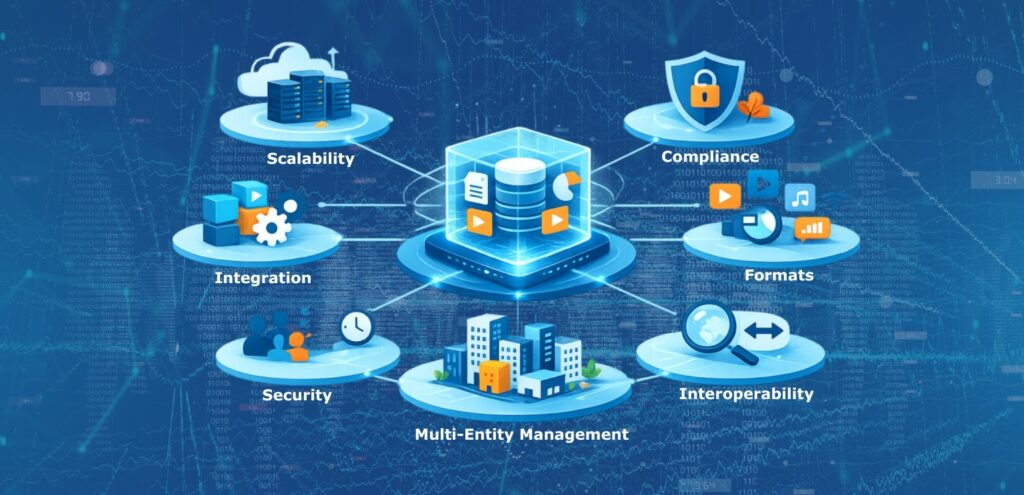
The adaptability of an Electronic Archiving System (EAS) is essential to support company growth, comply with new regulations, and integrate emerging formats or usage patterns. The following are the main areas of evolution to anticipate:
1. Scalability and Management of Growing Volumes
- Choose an EAS capable of handling the explosion of digital content and the continuous increase in data volumes to be archived, without compromising performance or security.
- Plan for a scalable architecture (cloud, hybrid, or on-premise) that allows storage capacity to be adjusted in line with business growth.
2. Ongoing Regulatory Compliance
- Ensure that the EAS keeps pace with constantly evolving standards and regulations (NF Z42-013, ISO 14641-1, GDPR, and sector-specific ones such as Solvency II, AMF regulations, etc.) to guarantee the legal value and compliance of archives.
- Implement regulatory monitoring and regular update processes to incorporate new requirements into the system.
3. Integration and Automation
- Opt for an EAS equipped with connectors and APIs to enable seamless integration with new business applications, ERP systems, document management systems, collaborative platforms (O365, SAP, SharePoint, etc.), and data management tools.
- Automate archiving workflows and metadata management to reduce manual interventions and improve process reliability.
4. Support for New Formats and Data Sources
- Anticipate the arrival of new document formats (audio, video, structured data, IoT, social media, etc.) and ensure their long-term preservation and readability.
- Plan for management and indexing capabilities suited to an increasingly diverse range of content.
5. Enhanced Governance and Security
- Strengthen information governance through appropriate frameworks, cross-functional archive management (paper, electronic, or hybrid), and integrated security (encryption, access control, traceability).
- Maintain a high level of protection against evolving threats such as cyberattacks and data leaks.
6. Flexibility and Multi-Entity Management
- Anticipate archiving needs for complex or multi-entity organizations, with governance frameworks that accommodate multiple archive custodians or third-party archivists.
7. Search, Retrieval, and Interoperability
- Enhance unified search and fast retrieval capabilities, even during migration or provider changes.
- Ensure EAS interoperability to facilitate reversibility and archive recovery under all circumstances.
To future-proof your EAS, choose a scalable, interoperable, and regulation-compliant solution capable of integrating new formats and connecting with your entire digital ecosystem. Anticipate data growth, increasing complexity, and regulatory changes to ensure the longevity, security, and value of your electronic archives.
To learn more about the implementation or evolution of your EAS, contact our team !